Marketing ROI Navigation Board
Plan channels, formats, creatives and budgets on a timeline, then watch return on investment, ROAS, CPA, gross profit and brand value move in real time. Compare scenarios side by side before a single euro is committed.
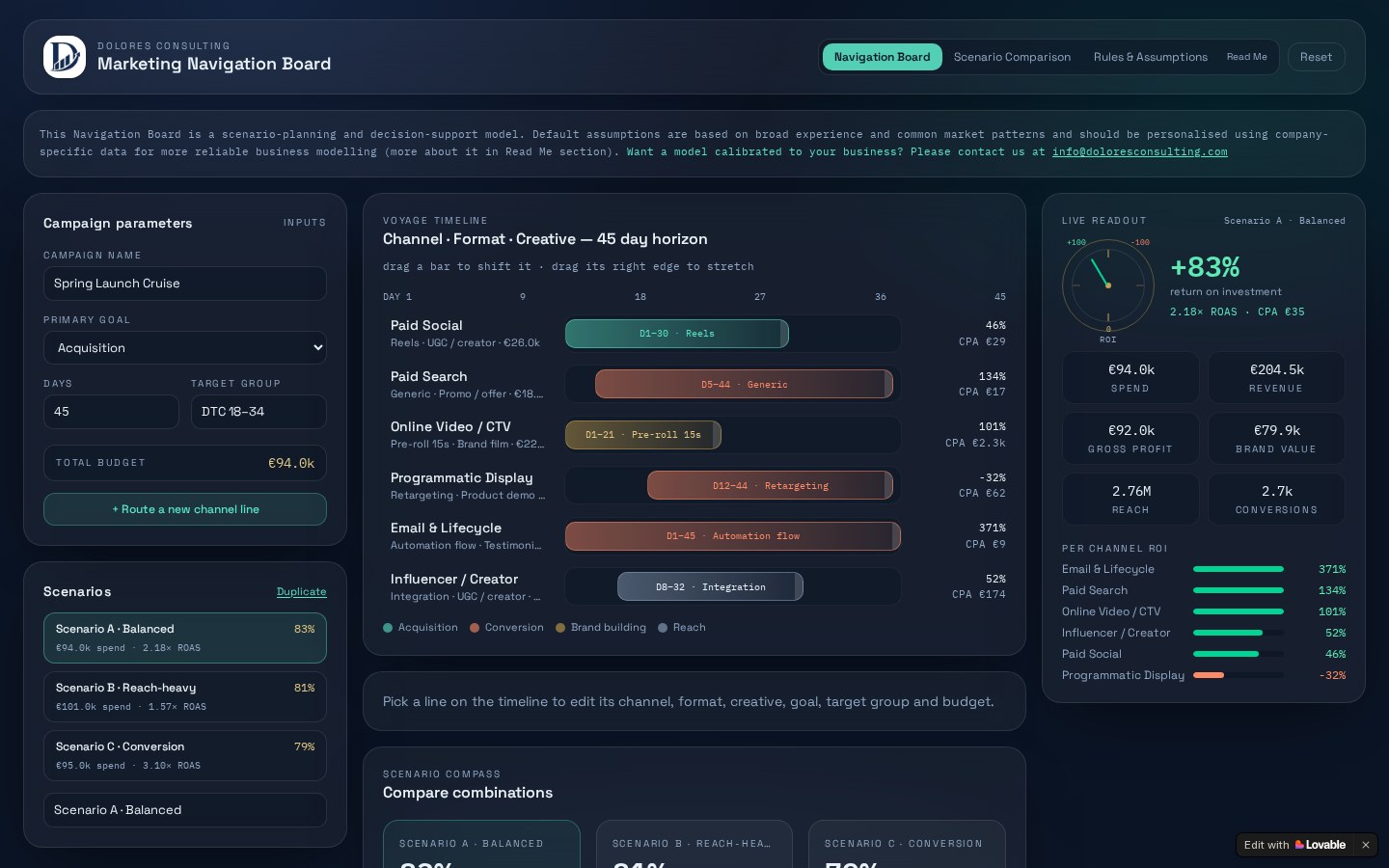
Campaign parameters · Voyage timeline · Live ROI readout · Scenario compass
A decision support model, not a universal formula
Please do not apply it without thinking about the numbers included in the estimation.
The board helps businesses explore, compare and plan marketing investment scenarios. It was developed from more than ten years of marketing practice, industry research, campaign benchmarks and patterns observed across business types, industries and channels. The default assumptions are a useful starting point, but marketing performance is never universal. In real engagements, assumptions are not assumed: they are calculated or statistically predicted from the actual business data.
Treat the defaults as planning assumptions and directional benchmarks, not guaranteed predictions. The most reliable results come from calibrating the model with your own data, historical performance and business specific assumptions.
Areas that require company specific personalisation
- 01
Brand value and long term impact
Audience quality, brand lift, future purchase probability, customer lifetime value, margins and market size should be calculated for your business, not assumed.
- 02
Different channels require different models
SEO may deliver over months, email within hours. Attribution across the click chain must add up to 100% of the journey, not more, not double.
- 03
Attribution and channel contribution
Channels rarely work alone. Contribution assumptions should follow your customer journey, analytics setup, CRM data and sales cycle, statistically calculated and A/B tested.
- 04
Creative effectiveness
Messages, formats and concepts move attention, CTR, conversion and recall. Creative effect can rarely be captured by one universal multiplier.
- 05
Objectives and optimisation strategy
Reach, conversion, acquisition and brand campaigns behave differently, and the outcome depends on bidding, targeting, conversion events and campaign structure.
- 06
Duration and timing
There is no universal minimum effective campaign length. Timing depends on channel, business model, sales cycle, market conditions and history.
- 07
Saturation and diminishing returns
Performance is not linear. Doubling spend does not double conversions. The turning point is specific to your spend history.
- 08
Industry and channel benchmarks
CPM, CTR, conversion rate, AOV and frequency defaults are planning references. Your own historical performance always beats a benchmark.
- 09
Reach, overlap and cross channel effects
Audience overlap, duplicated reach, assisted and delayed conversions all change the picture. Every product has its own click chains.
- 10
Uncertainty and prediction ranges
Market shifts, competition, seasonality and pricing cannot be known in advance, so the board models conservative, expected and upside scenarios instead of promises.
Build a model for your business
Every company is different. The board can be developed further with your own data, so company specific assumptions and findings replace general benchmarks. The goal is not a universal answer. It is a model that helps your company make better marketing investment decisions.
info@doloresconsulting.comPersonalised analysis can include
- ·realistic channel benchmarks
- ·conversion assumptions
- ·attribution and contribution
- ·customer acquisition costs
- ·consumer journey
- ·brand and long term value
- ·saturation points
- ·diminishing returns
- ·campaign duration
- ·cross channel effects
- ·ROI scenarios